
Wedge Studio
The twelve steps of approaching idiosyncratic creative projects
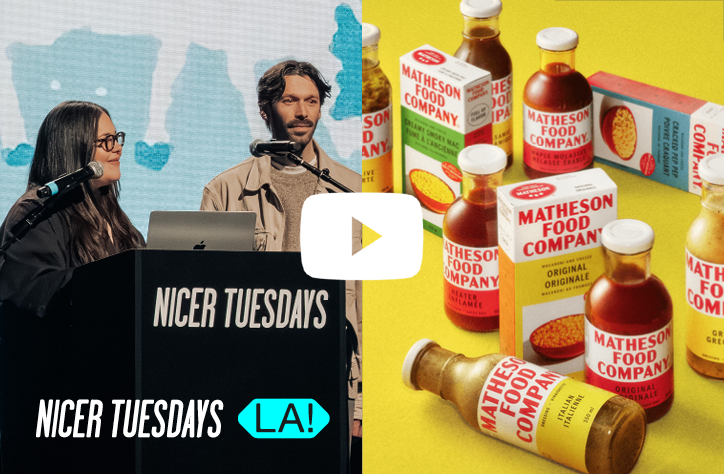
“We really do believe that we can create the future by pulling from the past. It's a great reminder to look beyond the internet.”
Hi LA. Hello everyone. Good evening. Nice to be with you guys tonight and thanks to it's nice that for the invitation. Um, thank you for the warm introduction. So um, yes, as uh, she was saying. So we're very excited to be here tonight. My name is Justin. I'm founder and chief design officer. I'm Sarah. I'm co-founder and chief creative director. So, Wedge is a studio for distinction. So, we work across uh strategy, identity system, packaging, campaigns, and special projects.
And we're actually based in Montreal, working worldwide. So, famous vehicles. [laughter] Uh this is our HQ, affectionately called Wedge House. It's a two-story house that we converted into the studio. This is a peak uh into our library. Our kitchen with a 12-oot table where we like to have staff meals and a glass of wine. Uh our living room with our infamous horse painting. The atellier on the second floor and a garden. That's my little dog where we like to have meetings uh with some birds. Um, but Wedge isn't just Justin and I. We're a beautiful team composed of talented folks across Montreal, New York, Berlin, Boot, and
Paris. Um, we are intimate and mighty and we like it that way because we take a limited number of projects each year in the pursuit of quality over quantity. Um, so some of you hopefully maybe know our work or maybe you don't. that's why we're here tonight. Uh but there's one thing that's been true over the last 10 years. So we I founded the studio in 2016. Uh is that I mean we like to say that we've actually designed a lot of seemingly unsexy sounding things. Um when I started the industry has changed a lot and so things like dental floss, unscreen, beans, beans people, and protein powder. Um we love elevating
everyday things that becomes one-on-one in their own categories. Um there is a driving force and wedge was really born out of a simple optimistic belief that we try to prove every day in everything that we do and we coined that as everything can be special. So here's some of our work. [music] [music] Heat. Heat. N. Heat. Heat.
[music] [music] [music] [applause] So when it's nice that asked us to come and give this talk, we asked them what do you want us to talk about. Um and they said probably talk about something that people can't see uh on the internet by looking at your website and we said okay. They also asked us how do you do what you do? And we're like ah we actually have a way called the wedge way. It's 12 principles that how we do what we do and we share those with everyone that joins our company. Um, so we're going to run you through those.
And it's nice that also gave us 12 minutes, so you're only going to get five out of the 12 principles. Here we go. Here we go. The best ones. Okay. Number one, nothing is boring. It really just is a matter of a point of view and your state of mind. Uh, everyone always asks me, Sarah, what's who's your dream client? And when I was 22, I would be like, oh my god, I I love Nike. I started my career as a words person. I was a writer doing global advertising. They had the best words and I really wanted to write their words.
But if you ask me that same question today, my answer without hesitation is anyone and anything with potential because I really do believe that everything deserves a certain level of curiosity. Um, and there's always something to fall in love with. If you can't find it, you got to keep digging till you do. Um, and curiosity and optimism are definitely a life force. So, exhibit A, are you inspired? Um, we often meet companies at a stage when they're ready to level up.
And what's so cool about this company that you'd never know by meeting them at face value is that they were into AI before AI was AI in 2021. And they were using AI diagnostics to create custom skincare formulas super specific to various needs. And they were meeting people where they were at. And we actually got to do a line of uh custom packaging through capsules. They were very sustainability-minded. So that was also very exciting for us. Um and as for as scientific as they were, they were really into putting the person first. Um so it was this idea of clinical made personal and that truth gave way to a whole system. Um and the big brand idea that we articulated for them was skincare formulated to evolve
with you. So, it's their superpower that was hidden in plain sight that was articulated and brought to the surface. Which brings me to principle two, stand for something. Or in other words, have a point of view. Um, we like to say that story is the oldest technology humanity has. We really believe this and it's the best way we know to package information.
A story gives us something to rally around. It's a single reference point to get everyone on the same page without the clumsiness of words. [snorts] And often even the most successful brands don't really know what makes them special. Our job is to ask the questions that help them find it. So meet Coco Lab uh when we met them. Delightfully different. Okay. how um the true life force behind this company is actually uh a dentist and an artist who founded it and all they wanted to do was bring joy to the space and bring joy to oral care.
Um so a brand's most authentic reason for being is typically hidden at its core. um it's always the one most truest thing. And so our job is to bring that from the background to the foreground and articulate it in a way that anyone can understand. And that became your daily hit of dental dopamine. So all of the work we do, all of the design work we do uh serves a purpose which is to tell that story. If the audience is going to feel it, we have to believe it.
Um, and what's pretty cool about working with Coco Lab in our design workshop, we said, "Ah, well, what if we could create floss that was worthy of the MoMA store?" Um, they signed on to that vision. So, if anyone here's from the MoMA, you can give me a call. Okay. Point of view is also the enemy of generic. We definitely don't play that game. And when we met a Kip, they were definitely one of many. Their truth was totally buried. a company totally obsessed with quality boine protein connected to the land not engineered in a lab. So we pulled that truth to the surface.
A north star that's strong and clear really unlocks a whole world of potential and we magnify it until it's the only thing that people can see. So instead of a woman jogging on the sidewalk with her bag of protein powder, maybe we're in Ohhigh and we're bringing emotion to to something quite functional. Which is also why you just can't make this [ __ ] up. Um when it's magnified 1,000 times, everyone can feel if it's real or if it's fake.
Or a tea company that reminds us to slow the now. And again, these north stars always guide design. And if you look really close at Razie, the identity is inspired by block printing. It's a handdone craftsmanship technique that takes time. Belief number three, I'm going to pass the mic to Justin. Okay. Tone. I'm obsessed with tone. We obsessed with tone. Okay. What is it? It is the thing that people see. Uh, no.
Tone turns design from a thing people see to a thing they feel. It's the thing we feel. We all see things, but how you feel thing is that visual tone. And it's about owning a visual position that resonate. And we pay an absurd amount of attention to details because there's no choice that doesn't matter. And the ironic things with tone is that for as much as we do visual work, it actually starts with words.
And if I say blue, take a second, think of the word blue. You might think of the sky. You might think of the ocean. I think I may think of a blue jay. The thing that's so hard with words is that we all have such a different definition of them and they can take so many different shapes. So when you actually start building visual worlds, the hardest thing is to find the tone. And so this is a very good example um from the cutting room floor of Grammy, which is a better for you Italian food company that we've built.
And on the left you can see those keywords and on the right uh those visual tone or the visual strategy as we call it. Um and so the reason why we obsess so much about tone is because it is such a subtle combination of very subtle details that once you start putting them together it creates that energy. And in the case of Brammy, uh, bold might be coming from the logo. Uh, the authenticity might come from a color or, you know, that playful energy might be coming through illustration. And so when you start mastering all those elements, you're able to craft something that people can actually feel. And that's what you see on the left, uh,
which is actually our first draft, first presentation to the client. And on the right, um, they hated it. No, it's true. True. They did. They asked us to start over. Um, but it's also a great reminder that for us, we are obsessed to find the right tone. And while the details might not be all solved, as soon as you start going into specifics, it might be that a logo is not big enough or, you know, some information might be missing. But if you nail the foundation, you're actually able to build an entire brand world around that feeling. And so this is why obsessing about what it feels like is so important to us because once you've you've got that right, the rest is so easy.
And actually if you want to do something different, um it really doesn't help to look at what everyone else is doing. Um you do have to be aware of obviously the internet uh or look at its nice once in a while every day. Um, but at Wedge, uh, we're all about what we call cultural foraging. Um, we're really about looking into different industries, different space and time to pull references, you know, from anywhere that can actually make brands feel entirely new while also feeling very familiar. Um, I love this example. I'm sure everyone has seen this uh poster from Milton Glazer from 1966.
Um, but it's such a great story because we see this poster as such an original artwork, right? It's like iconic. It's special. But, uh, if you if you guys know actually the story behind this poster, uh, Milton was in a museum in Paris, he saw this portrait by Marcel Duchamp that was actually done like 10 years before and at the same time, Milton was working on uh, he was studying Islamic art. And so those two references are actually so seemingly disconnected, but when you look at the poster that he did, and I love that he's very honest about those references, like it's in a book that I found in a vintage shop. Um, but this
story is so so great because it really is part of the practice that we also have as the studio where we connect things that might not seem obvious in the first place. Mhm. And so we really do believe that we can create the future by pulling from the past. It's a great reminder to look beyond the internet. Um but yeah, the past is as valuable uh to create the future and we so we thought it could be super fun to share some cultural foraging behind some of our works.
Uh lentils, I love lentils fiber. Uh so we had a project where we had to survey you know we were working on a South Asian pantry and so we're like okay let's go back in time and let's look at authentic products and we noticed a strong use of shape in the language of lentils which inspired a modern South Asian pantry known as parro. Mattie Mat's favorite childhood snack uh inspired his own line of straightforward goods. Homer Simpson's iconic beverage of choice inspired one of our first projects back in 2017, which I think is still pretty fresh almost 10 years later. And a bag of flour inspired a different way of looking at protein, something that's not
as functional, but belongs in your pantry beside flour and eggs and butter, like any everyday staple. Um, beautiful European architecture inspires elevated oral care. The Dell Sassoon, the hair icon, inspired an icon known for her hair. A 1940s poster by an artist by the name of Depro inspires a new way to drink wine.
And street wear obsessed founders inspired a totally different way of thinking about vegan ice cream. So, we often hear people say inspiration is everywhere, and it's true, but it really is often found in the unexpected. Which brings me to the last point, which is maybe the most important. Authenticity is distinction.
It's really cool to be authentic. As cheesy as it sounds, only you can be you. But that's also how you land a one of one. At Wedge, we like to hit three things. Designing for memorability, desiraability, and longevity. The distance between design and the market can take years. We're working on projects that some will come out in 2027, 2030.
So, following trends can make your work outdated before it even lands in someone's hand. We don't want our designs to ever look dated, so we try to make them impossible to date. they're in response to the times, not of the times. And with that, uh, it's important to remember the people we're also working with. Um, it might be one project to you, but to your client, it could be all their skin in the game. It could be why they joined this company to do this project. It could be the big hit of their career. It could be the one of the next two, five years. So you never know what project is going to be the one and the one that you're also remembered for.
So you have to act like each one will be the one. And at the end of the day, this is the work that we do day in and day out. I'm sure a lot of you can relate. Um, and it's the thing people will know you for. So you should put your heart in every single one. It's literally your legacy. Thank you. Thank you.
Latest Talks
-
Mother Design
Mother Design on why packaging is the only thing a designer can say to the customer
Watch -
Lily Kong
How painting offers self-discovery and connection with memories
Watch -
Alfie Whiteman
From professional football to photographing toe wrestling
Watch -
Jazz Grant
Using mixed media as a narrative device for dual heritages
Watch -
Daisy Chain
Reimagining Crack Magazine with slime-inspired 3D motion design
Watch -
Kelli Anderson
Tactile typography and graphic design as fine art
Watch