
Jazz Grant
Using mixed media as a narrative device for dual heritages
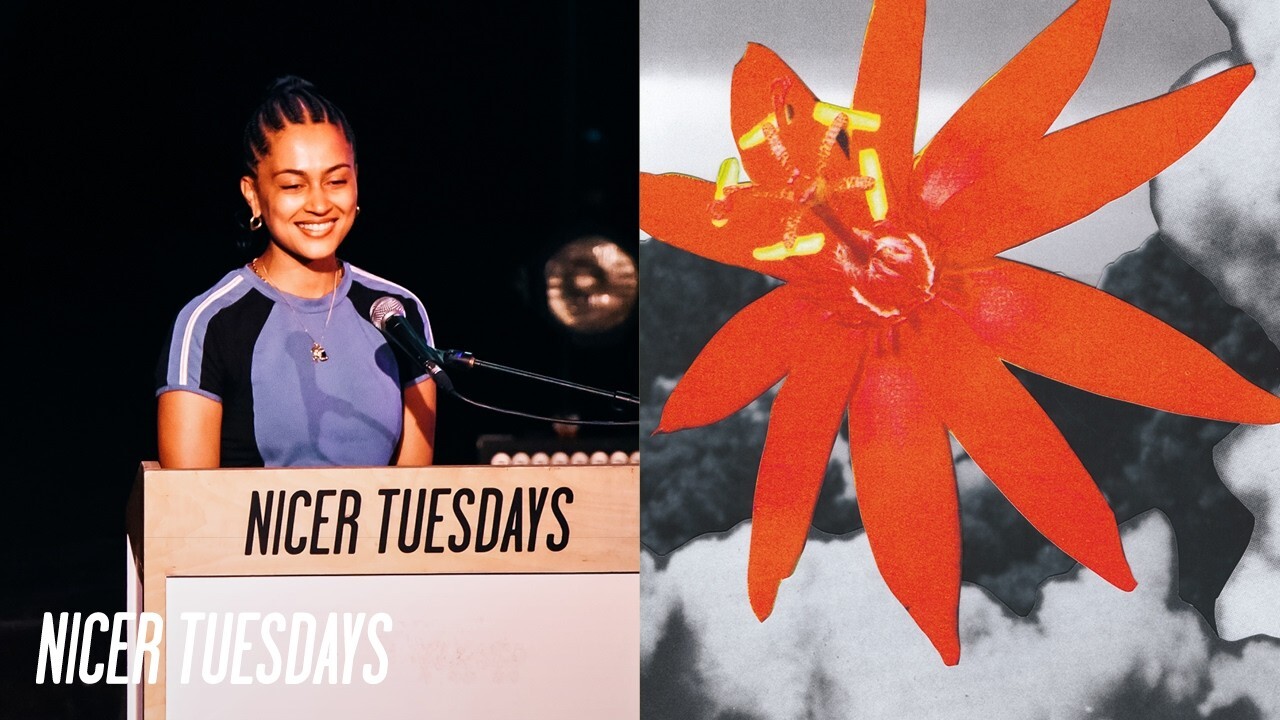
“You spend all this time collaging with these frames — you know that the man is walking or you know that the fire is barking — but when they're put together something magical happens that you can't really anticipate.”
Thank you. Hello everyone. Um, so I'm Jazz Grant as you just heard. Um, yeah, my practice definitely always sort of surrounds collage in some way, shape or form, whether that's 2D artworks, uh, stop motion animation and um, increasingly sculpture. I thought I'd give a little background and um, insight into my journey and how I got here. Um, so I studied fashion, men's wear design specifically, and collage was a way for me to bring ideas together, um, think about form, texture, color, concepts, and, um, kind of find a way to cohesively explore them, um, in like one dynamic image. But at that point, I was also using collage in the actual designs. I kind of liked a collagey
garment. I was really interested in pockets at the time for this particular garment. And I um really like like patchwork and applique processes. And on the left is a photograph by Miss Ohio um of that same uh shirt which I then collaged for boy brother friend which was like one of the first commissions I got. Um so I didn't really think of collage as anything other than like a part of my process.
But then um I guess I was sharing them online and um at one point Bianca Saunders who graduated men's wear fashion at the same sort of time as me, she invited me to display my collages in an exhibition that she was putting on. Um which was actually kind of the first time I thought of them as artwork and I created a body of work with that central idea. Um, I always worked with found books, magazines. Um, and I've been interested in thinking about history and how we document the past and how we interpret things, really important momentous people or moments in time. Um, and so that was like a body of work that really allowed me to kind of flex in
that way rather than individual pieces that I was making. Suddenly I was making like a body of work. um same kind of year I was asked to create some artwork for love magazine. Um this was kind of an unusual moment for me because I was actually more successfully entering the fashion world through collage whereas with the fashion design areas it was a constant struggle but I think it was a real reflection on leaning into the things that actually suit your way of working. I think with fashion I was trying to fit a mold that wasn't actually suited to me.
Um, yes. So, I got asked to do the dazed cover, um, which was an incredible experience. They teamed me up with No Name, the rapper. Um, and she came up with this, uh, title for her contributions. I feel like someone dreamed the world that we're in, so why can't we dream of something else? So, that was my starting point. And through, I guess, my visual language and the images that I wanted to sort of work with anyway, I was able to kind of respond but also create something that felt quite holistically in line with, I guess, my way of working. Um, so yeah.
Oh, I thought I'd show you a little bit of like how that looks. Um, basically just cutting and pasting until something starts to feel right. Um, and it's all physical. Everything's printed out and um, just chopped up basically. So, in 2020, sort of around that time, my brother Toby had recently taught himself how to animate with these amazing drawing skills. But we were having these conversations about how amazing would it be if we could breathe life into my collages. And we kind of sat down together and um he showed me the processes of stopotion animation.
And through like um screenshotting furiously as we were watching like found films, we printed them off, collaged with every frame, and then reanimated it. And honestly, that was like discovering a new dimension or something. It was such an exciting moment because I didn't you don't really know how the images are going to react until you see them once they've been animated. So, you spend all this time collaging with these frames. you know that the man is walking or you know that the the fire is barking but when they put together something magical happens that you can't really anticipate. Um so I thought I'd show you this first. Um so I see Rying Sun is like my first
iteration on um a way of working that we had developed together. Um, I was lucky enough to work with Justine Henzel or I asked her for the permission to work with The Harder They Come as she's the daughter of Perry Henzel, the director and she granted me permission so I created this film. [music] Oh no.
[music] [music] [applause] Thank you. [cheering] Thanks. So um yeah, sort of I guess happening across this collage animation process really opened up new ways of working for me. Um really loved it and I started to get commissions through I guess again sharing them online. Um I was lucky enough to work with um some musicians and some fashion brands. Most recently, I did a third animation for Hermes, um, which was really beautiful, and they really gave me the space and time to create again an animation where every single frame was made by hand. Um, I thought I would show you though the music video I did for Georgia Smith and um, Maverick because again, um, they really recognized the process.
Previously with commissions, I've had to cut some corners and I wasn't able to make every single frame by hand for because of time and budget. But here I was and they didn't really give me any guidelines on like what to create. They just wanted me to respond to the film. Um, so I'll just show you a bit of that one. Oh, this is also some behind the scenes so you can kind of see how ridiculous it is in some ways. Um, it can be really overwhelming but super gratifying and it's so unique in some ways to be able to see a film literally laid out in front of you. Um, and then to see it come together is like a whole other thing. Um, so this is that.
[music] Even though I tried, even though I [singing] cried, even though I made mistakes, but they were for you. After all I've [singing] seen, you treat me badly. I can't wash away your sweet taboo. And I finally found myself. [singing] And I'm tired to the wreckage of you. Terrified that I'm under your spell.
[singing] Don't want to lose. [music] Don't want to lose. And I keep on loving [singing] you. I keep on loving you. I keep on loving you. Got all of me in misery and I keep on loving you. [singing and music] I keep on loving you. [singing] But all of me has fallen for [singing] you. Even though I tried. Even though So that was the first time I also [laughter] sorry thank you. [cheering] [applause] Um uh it wasn't the first time actually but basically as I was creating more and more animations I was having to expand my team. It's physically impossible to do all that cutting um and animating on my own. Um, so yeah, it was really
interesting and I really um am grateful for the team who seem to be just as enamored with the process and the um ways of working as I am. Um, yeah, so that was really cool. But I guess my main focus has always been the physical artworks. I really wanted to find ways of expanding on this collage practice and think about ways of making them a little bit more mixed media. Um I think because they start the collaging started as part of a process, they continue to feel like something that I wanted to develop onto something else. So I was finding ways to sort of paste them onto wooden boards and incorporate like acrylic paint and
different mediums and thinking about different ways that I can expand the scale as well. Just using a simple printer scanner, but sort of printing them out as almost like tiles. um blowing them up and um being a bit more fluid about the ways that I was collaging them um and I guess expanding my research from these sort of historical books that I was finding and incorporating them with film stills and um books also on like landscapes. I was interested in pulling together landscapes from like Yorkshire alongside landscapes from Jamaica and like thinking about migration and um yeah things in that nature.
Um this was mentioned earlier but basically I was asked by the Windrush amplified art grant um to create an artwork. They teamed up with the VNA East and um every year they do a um commission by an artist who has some connection to the Windrush generation which my grandparents uh were part of. Um it was a really interesting experience because I was going to the museum to do this residency where I would try and find objects that related to my practice or related to this idea of celebrating the Windrush generation.
But I work with photographs. So it was very much like the the process of going to the museum was inspiring me more generally and then I had to find images that suited my way of working and also kind of like related to this brief. Um, and by doing that I I actually asked Howard Gray, who has become a kind of family friend of mine, but he took these incredible photographs of West Indian people arriving in Waterloo um in 1962, which was just before they changed all the laws on migration. And these photos actually were when he first took them, they weren't able to be developed. They lay too dark and um he thought they were unsuccessful. He held on to them for 50
years though and 50 years later he came across process by watching this program and um he found a way to develop them properly and 50 years later they all emerged. Um, so it's this really beautiful story behind these photographs and I'd always wanted to ask him to work with him in some way and I'm really glad I waited for this particular project because um, through doing this artwork, it happened to coincide with when Hackne Library, Hackne Central Library was doing renovations and they realized that they could use the artwork as a mural um, in the in the new library. So that is now in the Hackne Central Library um permanently which is really beautiful and the guy is actually like mansized which is pretty cool.
Um more recently um I actually went back to study. I wanted to again I felt like there was still something I wanted to to explore in my practice. um I was finding the my processes a little bit limiting and um yeah so I'm on currently on the print um MA at the RCA and this is a collage I did recently which was um still in the same sort of way of working that I have been um and on the right that's a a large scale print that I did for an exhibition but what was more interesting to me at that time was being able to use screen print for the first time so Now all these individual images that I had found, I was interpreting them again through choosing the ink colors, choosing the paper, changing the paper color and the materiality. And it
was it meant that I started working as more of like a series um rather than just like one individual artwork, which felt quite interesting to me. Um and yeah, this is a my most recent project essentially. Again, the foundation of this project is thinking about history, thinking about memory and thinking about like what is or questioning our ways of um thinking about the archive and how do we how do we present the stories and which stories do we choose to hold on to. Again, I was able to use the screen print process and um kind of develop the colors. But what I was most interested in with this latest project was thinking about how do I take up space in a different way. I
think in a way harking back to my fashion design days, I liked the idea of going from 2D to 3D. And this in a in a sense was like almost the most logical way of doing that. I was screen printing on wooden structures and in and just focusing on like the inside of a collage and suddenly the inside of the collage becomes the exterior um and slotted together in a really simple way. But for me it was almost like the feeling I had when I first did this animation. It was like another dimension was being accessed in again quite a simple process but something that was really um exciting for me. And this is the recent
display um of those pieces. So yeah, I was just going to end with saying that for the long time I told myself that if I wasn't a fashion designer, I would have been some kind of failure. [music] And it wasn't until I kind of leaned into the things that felt more natural to me and the ways of working that were more organic and I let go of ways of working that didn't actually fit my kind of person that work was being made in a more organic and natural way. So yeah, that's what I wanted to end with.
[cheering and applause] Sync to video time
Latest Talks
-
Mother Design
Mother Design on why packaging is the only thing a designer can say to the customer
Watch -
Lily Kong
How painting offers self-discovery and connection with memories
Watch -
Alfie Whiteman
From professional football to photographing toe wrestling
Watch -
Daisy Chain
Reimagining Crack Magazine with slime-inspired 3D motion design
Watch -
Kelli Anderson
Tactile typography and graphic design as fine art
Watch -
Noble Signs
Restoring NYC’s storefront signage through graphic design
Watch