
Lily Kong
How painting offers self-discovery and connection with memories
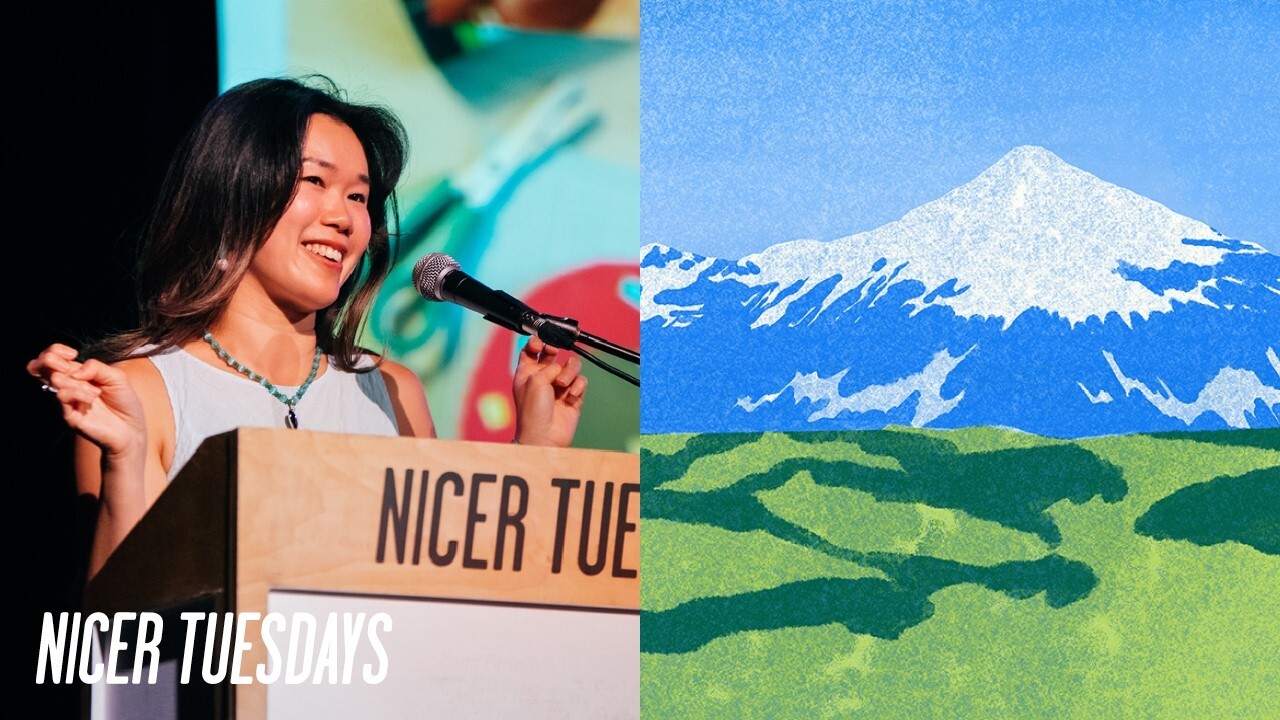
“Art isn't just about the talent or the success. It is also about self-discovery.”
[applause] [cheering] Hi everyone, thank you for coming and thank you for the really generous introduction by Olivia. So today I am going to talk to you about how to use an illustration practice to research things, investigate ourselves, make people laugh, make people feel, and always stress ourselves out.
First thing first, a quick introduction to myself. I'm Lily. I am an illustrator. I was raised in Hong Kong and now I live in London. So my best, absolute best talent is in being a princess as you can see and making birthday cards, Mother's Day card, my parents wedding anniversary cards and cards for my cat Pudding. And this is it is a skill that I have acquired since I was three years old.
So, you can call me the card master. Some of you may have seen me before. Last time I was here, I talked to you about the pandemic and my post-traumatic responses to it by basically asking lots of strangers for their saddest stories and making funny drawings about them. Very ethical. My work has always been about sparking joy using illustration. When I started, I make humor a big part in my work.
It is great in bringing lightness to talking about seriously sad problems. And at the time of pandemic, feelings of fear and despair thrive in isolation. One way to combat these feelings is to connect with our local and digital community. Now then then here are some shameless plugin. Oh seriously here are some updates um on what I have been working on as an illustrator in the past five years. So I started doing a lot of event drawings with different shops and fashion houses including Hermes and Mlanc.
Depending on the brands, I alter the way I draw in each event. Like this one with Bomblanc, I incorporated a lot of ink and their infamous fountain pens in the drawings. For Hermes, I added decorative borders and motifs to match the floral theme. At the time, event drawing has really opened up a different route for my illustration practice.
I also did some illustrations for websites and branding like this one for design job board. I love working on editorial illustrations particularly on topics that I'm already interested in like these for NPCC and these form Imagine 5. This year I got to challenge myself by designing a logo for a wonderful platform secrets worth sharing which aims to give approachable advice on talking about child sexual abuse.
I'm also teaching illustration here and there in different institutions which has been a very challenging but very rewarding journey. But today I'm don't want to talk about any of my clients project and instead I would love to share my personal project called Sweet Escape. The project started because I felt like something is missing in the creative process while I was doing all of that really good clients work. And I feel that I'm just too efficient, too good at it. And I thought something could have been done differently, but I wasn't entirely sure what it is.
Perhaps some of you will resonate with this. When I'm working on a client's project, I always go first with concept proposals, first draft, second draft, sometimes a third round of amendments, and then bam, it's done. And within this process, I kind of want to find out more about what I could have done between point A uh to the finish line.
Investigating ourselves can be a good way to start. And my working method has always been tailored to who I am as a person. I'm eager to find small ways to move away from my current working approach. And here are some extra steps that I took in the investigation. Like a lot of creatives, I practice observation with sketching wherever I go. I collected a lot of notes, sketches, and photos. And so I decided to start with this archive.
I found a few recurring themes in this archive. And what strike me most was my collection of landscape photos. So I started treating these images. One of the ways um that I use is that I actively observe and dissect an image. For example, I went to area forest waterfall in Lake District years ago and I really loved it. I love the rapid water stream, the gradient transition of the landscape, the peculiar stones, the dreamy mist, and the many different shapes of plantations.
I started by outlining what I see and drawing it in different color blocks. I iterate the same image in different mediums and variations. These are mono prints with screen printing. It works a bit like a reverse painting. The process is super confusing, but it is unexpected and refreshing and it feels thriving.
I also tried to put an image in a very different space to see if it is um more alienated like printing this apple on an IKEA dinner plate that I didn't really want with UV printing. I experimented with reversing an image. I thought maybe I can make my painting process more unexpected. So, I taped away every shape of an image and build layers on top of each other.
With all of these things I've done, I love all of the textures from smudging ink, faulty making process, and bleeding paint. And basically, what I was trying to get to is to find more newer ways to make an image. The more unexpected, the better. Then I decided to make my own textures. I first made these monocolor paper collage. I scanned them. I play around in Photoshop and I printed them in layers to create these.
I feed these textures back into my work as both foreground and background layers. And they work especially well in actual collages. and I use them to make some of the work for Monkin notebooks in 2023. A lot of my creative process do involve looking back in my references. And on my trip to Japan, I found these really fun Ukio layer stamps in the ad museum in Tokyo. And I loved how restricting layers of an image can articulate the best of an image.
Here are some of my attempts to replicate the same feeling. I was particularly inspired by Uguan Jones ink painting and I love how tonal variations and the scale of his work conveys a really strong feeling of peace and a sense of belonging. A piece of work can be so articulated and refined but also being very dramatic.
By putting ourselves in the environment, we work with experiencing, becoming, and feeling in a way. I am kind of wrecking the material. In 2024, I had the opportunity to house these drawings and images into a book at a residency in London Center for Vogue Arts. I learned a lot about bookbinding and taking considerations on how the form of a book changes the context.
So the book Sweet Escape was born. It is fully rised, handbound. It is also very long, opens up like a door, you know, kind of like a telepathic door to beautiful landscapes that we want to escape into. At this point of the project, it is coming together. The work are obviously exploring free things, memories, textures, and flatness. And all of these seems to carry a sense of belonging as well.
The work offers not only an opportunity for personal explorations, but is also showing something bigger than that. It is a collective memory of being in a place we imagine, experience, and love in different time and space, but we're all together because we remember them. Sometimes when we are making work, we don't know where to put it or how to market it. It's okay. Like, we don't have to force it. And sometimes the work has its own direction. The longer you work on it, the more it reveals its true story.
The longer I work on this career as a creative, the more I discover that sometimes it's not really about the talent or how fast you can work on a project. Of course, these are all really important things, but practicing art is about more than that. Art isn't just about the talent or the success. It is also about self-discovery.
Whether we sing, we dance, we draw, we write, we act, the act of constant creating stretches us. It reveals who we are and helps us become more fully ourselves. The process may be difficult. It may even be painful. But taking the difficult road can help us grow in ways we never thought we could. At last, I get this question from other people sometimes. Where will personal projects lead to? Well, if you are lucky enough, uh you may be able to find the right audience and if your work is good, it might bloom. To sum up, don't go chasing waterfalls. Stick to the rivers and the lakes that you're used to. Thank you.
[applause and cheering] All From It's Nice That
Latest Talks
-
Mother Design
Mother Design on why packaging is the only thing a designer can say to the customer
Watch -
Alfie Whiteman
From professional football to photographing toe wrestling
Watch -
Jazz Grant
Using mixed media as a narrative device for dual heritages
Watch -
Daisy Chain
Reimagining Crack Magazine with slime-inspired 3D motion design
Watch -
Kelli Anderson
Tactile typography and graphic design as fine art
Watch -
Noble Signs
Restoring NYC’s storefront signage through graphic design
Watch