
Kelli Anderson
Tactile typography and graphic design as fine art
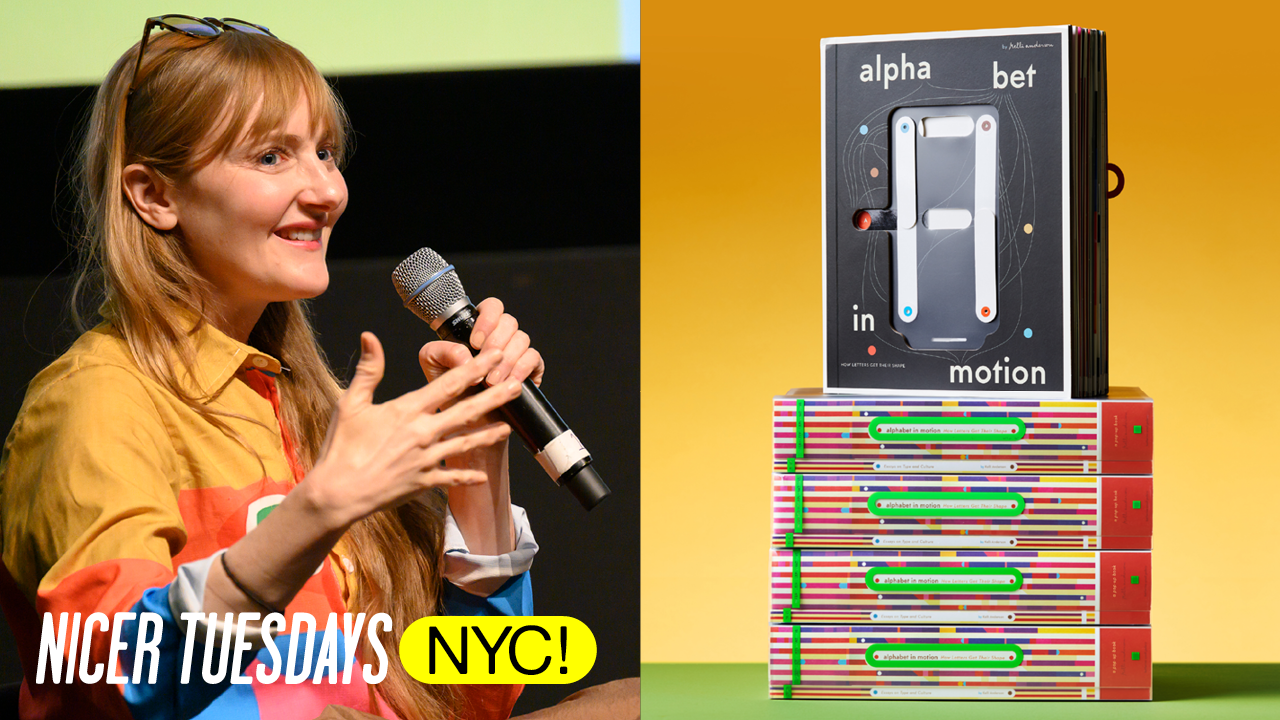
“If in your creative practice you ever feel like you're kind of in a rut, really share it with other people, because then you're going to have so many more ideas of the potential of what it can do.”
I think Kelly's wearing the greatest shirt I've ever seen. You said it was from Japan. It came from Japan and from a store that disappeared. Yeah, it was from a vintage store in Japan. And then my travel companion was like, "Where is this store? I need to go shopping." And I was like, "It's right here. You get off the subway, whatever." And I think she went to like 25 vintage stores and none of I was like, "Nope, not that one." Nope. There's always three in Mirage. Yeah. Desert. Yeah.
Um, so I've been following your work for a long time. Um, and admiring it. Um, would love to start by talking about this lovely new book. You sent me a copy and it was stolen by my neighbor. And then you sent me a second copy and it was so heavy that it got misdelivered twice. Yeah. Um, and when I finally got it, I was like, "This is the greatest thing I've ever seen." Um it is really like quite a feat of engineering. Can you sort of start with where you began this whole project? Well, thank you. Yeah, male male is a nightmare sometimes. [laughter] Um yeah, so the book is called Alphabet in Motion and it is an interactive exploration of how letters got their
shape. So, I mean, I think it started cuz I went to grad school for art history and like learned about how ideas are encapsulated in brushstrokes. You know, that you can look at paintings from different time periods and tell something about what people were interested in, like what philosophy ideas were like sort of like the framing narrative of that era. And I was like, I get like so much more of a vibe from tight faces. Why don't why don't I know this history? So, I just kind of like threw myself into this 5-year loan research project.
No, I mean um what I was really interested in was the sort of there's almost like a mismatch between different things. It isn't just, you know, like here's the pen angle for this one, then the pen angle for this one, then the pen angle for this one. You know, you talk about things like bit mapping um as it relates to letter forms or I never I don't remember what this A is behind you. There's like a a sort of um Eiffel Tower A. Yeah. Yeah. Uh, so the A was kind of like, are the shapes the general shapes? Like the A is a triangle. Was that an accident or was that something intentional? Cuz like look at that A.
Look at that shape. Like what does it feel like to you? Feel free to shout something out. Power, right? Stable, right? Yeah. So I mean the shape of the A originated in the ancient world and before they had physics and mathematics to explain why you know the A is you know the most powerful shape in engineering you see it in all infrastructure and all like bridges like at the you know base of like skyscrapers and whatnot. Um but you know it basically like takes gravity and distributes it to its wide base. So it like works with the grain of like how the forces in the physical world work. Um and the A is powerful because of its
triangular shape. And so you know I it was kind of like you know you can look at um I think my favorite thing I found was has anyone seen like the original abracadabra from like the second century BCE? So what is an abracadabra? Yeah. You know how magicians are like abracadabra of the steroid? This was like like a Roman cell that arranged the letters abracadabra like in a downward-facing triangle where they're like taking away a letter for every single row until you end up with just an A. And the idea was like that the shape was like so powerful in the physical world that like it could also work in
like the spiritual world. So if you were ill like you would wear this on an amulet and it would expel like the illness from your body. So um so yeah this idea of like you know letters like we use them to make words to make sentences to make paragraphs but they're also these visual things and like where do those visuals come from and what do they relate to? Why do we feel that way about an a you know or any any type face? So sorry I'm knowing too much. I'm talking too much. You are the subject of the event. Uh I I read a book last year that was called index the history of and it was about indices and there was a whole chapter about the
invention of alphabetical order. Wow. And I was the amberand used to be in there. Yeah. Well, it was et right for Latin. But um and I remember thinking like oh someone had to invent alphabetical order. And the funniest thing was people who when alphabetical order came around people were like this is going to ruin reading. It was really funny to be like, "Yeah, even since the 1600s, people have been saying, yeah, let's just go to rune reading." Um, so I mean, I don't know. I don't know what No, no, no. But that equal an abvisedium, which is different. But yes, I I wanted to say there's I think my favorite design quote of all time,
which you're kind of touching upon here, is by David Greyber, who is an anarchist, not a designer, but it's the best design quote. And it's like, you know, the great like, you know, secret history of the world is that everything was made and it could just as easily have been made differently. And so I think like what you're saying like, you know, the things that we most take for granted. I think those are the ones that are really interesting to be like, all right, what's in there? Flip the table, you know? Well, the the Latin alphabet is interesting because it's not really a Latin alphabet, right? I mean, that's a combination of Roman and Venetian and all these different forms. I mean, how
what are are there any interesting things have you kind of separate from the individual letters learned about the alphabet as a whole when you were working on this? Yeah. I mean, I think the most interesting thing I learned, which I'm really embarrassed I didn't know before, and I can't believe I'm admitting to an entire audience, is that capital letters and lowercase letters come from two completely different histories. I didn't know that. I was like, "Oh, they're together in this font. Great." But you know in actuality those capital letters like were you know chiseled all over Rome you know on you know they're
they're markers of their empire um and lowercase letters come from a completely different history altogether of Carolian minuscule uh calligraphy um the way that books were made before printers. So you know you had all of these scribes in monasteries who were like literally like copying books by hand. So, um, so yeah. Does everyone here know uppercase versus lowercase. Why they're called that? Do you know why they're called that? Yeah, because in uh tight tight setting printing shops in in the era of like hot metal or wood tight, you know, you had the uppercase capital of the letters on the upper and then the
literal drawers. It was called a case of drawers. [laughter] I mean, but that's genuinely how I felt like looking through this book. book and it's funny like I flipped through it again before coming here cuz I wanted to remind myself and I think I only made it to like K before I was like oh I'm out of town like gring it. Um I'd be curious to think about how did you decide which sort of the process of you know you know this history you're working on all these letters sort of deciding what's the most interesting history but then also what paper techniques are going to best kind of highlight was that more top down where you started with the technique per letter or bottom up where you started with the history. I love that you think
I'm that organized. So, this was like during lockdown and I was already feeling a little bit like a crazy person. Um, but I had made a literal crazy wall in my apartment. Do you all know like when they're like trying to find the killer and they're like, "Okay, there CIA and this." And like I just had like all of these, they weren't post-it notes. They were even like rougher than that. that there were just like taped up like little pieces of crap everywhere and I was just moving them around being like, "All right, like what idea goes with what popup physical construction as a metaphor, you know, just just moving them around until the book kind of made sense." And then I had
to send a I had to send the die lines and a blank prototype to my printer and I was like, "This is a house of cards. Don't let it fall." You know, don't say no to any of these pop-ups because I don't know how I'm going to reshuffle the deck. And of course, he said no to like three of them. It it worked out. Yeah. What was the I mean I'm sort of curious. How did you get into because I think it's sort of oversimplified to call this a popup because there are things in it that are like wheels and little There's one part that when I admittedly I have a student who's really into animation and I brought this in to show them and there's one little like plastic
piece of string that always dangles out of the book. I think it's near the end. Would you know what letter that is? Is that Z? Might be the Z. But um every time I always accidentally open the letter when I'm like carrying it. Um like how how did you learn all of these different techniques and get into this in the first place?
I I took apart other people's pop-up books, which I know you all are thinking is like a form of violence, but is this the only way to learn how to make pop-up books at um I actually I went to this conference uh it's called the the Movable Book Society. Does anyone Is anyone a member? They're a great society. Um, a lot of like papa people society. Yeah. If you need a society, it's like I'm serious. They're awesome. Like you'll go and there will be someone who's like 14 that's getting a talk and someone who's like 97. Oh, it's totally the most diverse crowd. Uh, and so like yeah, the Moodle Book Society, I went
there and I gave a talk about my work and I kept on meeting people. But I was like, "Oo, I took apart your book and your book." Hey, I just felt like such an impostor. But then I actually talked to someone about it and they're like, "Oh, yeah. That's how we all do it." So take apart a couple of books and you can glue them back together.
I don't know. I actually don't think I know a lot about when when they started. Is that is it an older art form than I realize? Yeah. Yeah. So, um, the origin of movable books probably started with Lothar, um, Megondorfer. So, there's, uh, he did like a whole bunch of like Victorian cards where you like pull a tab and then there's a series of paper linkages that like, you know, it's like a nice dinner scene and then people are like throwing their plates all over the table. So, um, yeah, there's there's a lot of those. I mean, it's it's fun because I think a lot of these things don't really exist on the internet. you have to go to special collections and even if you go to special collections,
you probably don't get to pull that paper tab. So, it feels like we have access to everything in this world except for those things. Well, also the feeling of watching a video of somebody spin a wheel is like not very meaningful. But if you like, you know, you give a kid a fidget spinner and they're entertained for three hours, like the book really is such a tactile experience. You almost have to actually experience it in person to really understand it. By the way, they're in the lobby. Oh, yeah. I have books for sale if anyone wants to buy a book.
Um, it's interesting that you mentioned Victorians because I I do think there's kind of a Victorian sensibility to a lot of the work you're doing. Um, I think it it's interesting having Noble Science having spoken that this relationship between design and craft is something that I think used to be a lot more common and is sort of falling away. But specifically as it relates to like Victorian toy making and papercraft, I think there was such a like early automatons almost remind me of some of what you're working on here. As I said, they sort of transcend popup. Is that is that the first time anyone has ever
No, no, I love that. Keep go on. Well, I just I was going to say um between the planetarium and the camera, I mean the early cameras were all paper boxes essentially. So, in some ways, like do you think of what you're doing as sort of inventing something new or knowing that you come from a history background, is it more about reviving these things that have already existed? Yeah, that's a really great question. Um, well, so when I designed this book as camera, which is like a popup pinhole camera, has anyone made a pinhole camera before?
Did it change your life? I feel like that's like one of my like conversion experience. So, I think of like Saul turning into Paul in that painting. That was like me when I used a pinhill camera for the first time. Um but um but yeah, like I I really really really tried to find a like a form that was both light tight and collapsible and it doesn't exist. Like it is a large format camera. It eats the bellows. Like that was the only way to do it. And so I feel like I'm always like trying to invent new things and sometimes like just like end up back at those sort of like historical mechanical things and
it's like how does this work again? So I think I made like 50 of them. I was like no it has to be a bellows. So and with the planetarium what were all the different pieces that were in there? I that one I do not own. Yeah. So this book is a planetarium. Um I worked on that project with Chronicle Books and I sent them 26 different gadgets. I was like, "This is the assignment I need to make." I like I visually looked around my apartment and I was like, "All right, if you know, civilization ends," which is always seems possible lately. Um, you know, like what things could I build out of paper so that I could like play records, take photographs, all of this stuff. Um,
and so that was my my weird little challenge. And so I sent them all of these prototypes and out of those they picked kind of like the most reasonable and easily producable ones. So, I sent them the camera and they're like, "No one's going to want to do analog photography in the future." [laughter] So, I was like, "Fine." Since we had another cyanotype mentioned today, I did see a really funny uh tweet and saw a tweet anywhere. I don't know what it's called, but I find interesting things on the internet. Um that said, you know, someone's really going through it when they start making cyanotypes. [laughter] And I was like, I just bought a pack of
snacks. Oh, that's that's so wrong. I don't feel that way at all. Beep beep and like he don't feel like a little I mean you did describe it as a serial killer wall. Yeah, that's true. But you know I've been in the heat and also it's not the pandemic anymore so I get uh I think a lot of your work kind of like is connected to a broader thread of revealing hidden things like whether that's processes or histories. Um why did you decide to study art history in the first place? Is that something that's always been part of your practice or or or more recent?
Yeah. So, well, I I enrolled in grad school to take studio art because studio art is what you tape when you want access to all the labs. Like, yeah, like I was like, why would I major in photography or graphic design and they're going to keep me in this space? So, um but you know, there was also the opportunity to get a dual degree in art history, so I did that. Um, but I mean I think it's like, you know, graphic design especially, it's almost like offering proof of some kind of perceptual magic. Um, that you can be working on a project and find some color combination that really like shouldn't work at all, throw in a tight face that
shouldn't cooperate with any of them, be like, "Wow, I'm really feeling this." and release it to the world and have it be like exactly what everyone else wants at that very moment. Um, or to like lay out a design and like feel like, oh wow, this is really for some reason like transporting me to like 1920s Paris and have someone else on the other side of the world look at that same design and feel that, you know? So, I mean, I think that like that sort of proof of like our shared social experience and perceptual experience is like really something that fascinates me and something that I was really like chasing to understand better like with this book. That is funny you
say that though because it when I went into this I assumed this was a very like technical process where you had a lot of spreadsheets and it sounds like it's actually a very intuitive way of making despite this resulting in a technical form. Yeah. Yeah. I was actually um really emboldened by has anyone read uh David Rinford's like a new program for graphic design? Yeah. Okay. It's really it's really quite good but you have bibliography for this talk already. Yeah. Yeah. Well, so he I think he's teaching the first graphic design class at Princeton ever. Um, and he's teaching it more like a liberal art than um than
how graphic design is usually u taught. But that book was like it was so intuitive like it wasn't like canon like graphic design history and I love that about it. like he was like drawn to certain things like Nunar's work um and um you know David Kuth's metaphant like all of these different things and I was like yeah actually like it's it's so great to like sort of like bring that gem from history like into our view right now because as a modern person like I'm interested in that too and so he kind of like trusted his intuition and so I was like that's what I want to do with my book too like it's good enough if I'm interested in it like I think other people will be interested in
it too. Like I don't feel like I need to like talk about Swiss design all day. We already know about that. You know what I mean? Well, and I think alphabets are interesting. I sometimes think about how every once in a while you'll, you know, encounter something that's designed and I'll see it like upside down. It takes you a second to realize you're looking at letters, but you can't help reading.
I mean, if you speak a language, you see it, you know what it means. You don't think about it. And I think there's something really nice about the alphabet as a format because there's so much variability. It's like as you said, an A is a triangle, an O is a circle, you know, and and there's a lot of room to play within these constraints, but so what happens when you sort of bring that intuition and it meets like a technical perspective? I love that you say that too because like there's a whole chapter in here that like asks like is a letter a structure? Like can you say that an A is a triangle or an O is a circle? And
this is like two different sort of like dueling philosophies that like really came to light like at the dawn of like digital type. So yeah, I won't talk too much about it. All I want is like please say more. Okay. So yeah, I'm like you're here. Yeah. So well um basically there's this guy named Donald Kuth who wrote the art of computer programming and he's just this like affable genius. Like he's the guy you want to be your like super duper smart grandfather. Um but like when type was coming to computers it was like this sort of philosophical question of like okay like how do we treat type on computers like you know it wasn't a given that it was going to be pixels or images or whatever and can was like the
way to take advantage of computation is to create it treat it like a choreography almost like a calligraphy diagram like if you're drawing an X say take your hand put a point at the top left draw down to the bottom right you know in the other direction too. So draw the structure and then you can add a whole bunch of like sliders basically for different parameters. So you want serifs like add a slider for serifs. You want bold, add a slider for bolds. And it was called metapont because like you don't need fonts, you just need this one structure and all of these like little sliders. Um, so there was a guy named Douglas Hawksteader, uh, who was like a
cognitive scientist, early a guy, early AI guy. Oh, we're talking about AI. I'm so sorry. Oh, so yeah, but you know, he was interested in AI because he was interested in understanding the human brain. Um, so understanding like what computers did well and what humans didn't. Um, so he came in and he's like, you know, possibility does, you know, more sliders does not equal more possibility and this is not how letters work and this is not how, you know, type design works at all. A letter is not a structure. And so he went off in this like other direction and created this project called letter spirit where he
and a grad student was like okay what's every possible structure that a human being will recognize as a letter A and there's like thousands of them and so they kind of engaged in this like beautiful super nerdy public debate where K's kind of like you know pet project was eviscerated and now like you can still play with metapont but there's a website it's called metaflop.com because it was a flop. But it was really interesting because it's like you know like this is the reason why it was so hard to teach computers language and how to identify OCR was like a very mature technology still like messes up sometimes you know um and it's because
the human brain is different than a computer brain and we have this like vast aptitude for like these context you know specific like flexible ideas of like what a letter is and how do we identify by it. Um, so you know, you'd be able to recognize there's I love the font uh pillow lava that was like a font. It was it was based on like how lava pools. It's like completely illeible and it's a but you can still be like, "Oh, there's an A." You know, it's so great. Like I love type faces like that where they're like, "Oh, I'm just going to like poke at the bounds of like legibility and see what I can get away with." Those are the best.
Um, I studied cognitive science in college. Oh my god, I didn't know that. I don't ask me how I ended up graphic design and history. Uh, fun fact is I've never really taken an art history class despite being a huge art history nerd. But, uh, and one of I remember there was a whole thing of it's called ecological perception, which is the idea of perception being something that is related to experiencing an environment not done in a lab. And one of the examples they talk about is chairs. And they say just do humans memorize every single chair they've ever encountered so they recognize a chair. No, they just
can see the like affordability of a chair. So they can actually just see what is sit uponable. You know, like a stump is not a chair, but functionally speaking, it's a chair. And that sounds very sim. It's like you don't memorize every possible permutation of a. There's just like this sort of aness that's afforded once it's in a sentence that gives you a feeling, right? But I mean there's like see mysteries in there because like letters evolved alongside us. Like we have no clue why we can recognize some things as a and others as not. Same thing with faces. Like everything looks like a face. So
paridolia is what that's called. Yeah, I believe which is different than propo pasnosia which is you can't recognize faces at all. My somewhere in the somewhere in the depths of my brain. Um I mean I'm curious like you are obviously very interested in sis pivotic slightly because I want to talk about your work because I think that is often what a lot of people um are familiar with. How did you first get into rg graph? Well, um I hang out a lot at a print shop called The Arm that used to be run by your friend Dan. And then, um because of the real estate situation in New York, uh my friend Keegan had his Rizo studio in the basement of Academy
Records and was forced to move um and unceremoniously and moved in with Dan. And so all of a sudden, I had access to a Rizo and I was like, "What is this thing for?" It's definitely for making animations. Yeah. Yeah. I mean, I think what's what I see the the thread between the Rizzo animations, the camera, it sort of is like I'm going to do this in the most difficult way possible.
Oh, yeah. And does it use this tool in fact in opposition to what it was designed for? Because my understanding about rizigraphs is it's essentially like digital screen printing and was like my dad always talks about how you know like wreck rooms and churches in the 80s would have them to make like flyers. It's supposed to be like all about making multiples and you're using it to make multiple different things singularly. Yeah, I mean that did offend the Rizo's owner.
He's like, you know, this is of how you're supposed to use this machine. I was like, I know. Isn't it delicious? What What do you like about it so much with animation? I think that it feels like it sort of flouts some of the traditional expectations of animation. Well, so I mean animation works because of perfection essentially. Like you are trying to convince the viewer that something is moving when it is not in fact moving, right? So, it works off of our precision of vision. Um, and it has to be lined up perfectly. And the Rizo, if you've ever used one, does not want to line up anything at all. Uh, so, so
yeah, those things are kind of at odds. But, you know, if you're staring upon a Rizo print, like there's a certain texture and a certain artifact that becomes even more apparent like when it's sequenced together as Frames. And so it just felt like just like the most yummy way to look at printing was like if you have like a series of prints that moving together. So I know you've been teaching Rizzo animation classes. Has that changed the way you're thinking about that as a medium as well based on seeing what other people are doing with it? Yeah, absolutely. I think like you know if if in your creative practice you ever
feel like you know you're kind of in a rut like when I first started doing rezo animations I was like fluorescent orange and blue work well together and I just did duo tone for like the first like three years. Um, and then I started teaching and seeing other people use different colors and I was like, "Wow, like this."
But no, that seriously like, you know, I think if you like have some kind of like technical discovery or technique or anything like really like share it with other people because then you're going to have like so many more ideas of like the potential of like what it can do. So, um, yeah, it's really cool. Like it's like really like a global like movement now. Yeah, I mean your work is very I think like what I enjoy about it is there's this combination of looking at what some might argue are very like technical dry subjects and bringing them into this space of like play and joy with color and texture. But I've noticed in when
you post about Rizzo animations from other people often it's like very literal photorealistic you know faces or with fourcolor printing which is just such a way of shifting that technique. Yeah. Yeah. Totally. I think we're almost at time. Okay, we have two more minutes. Um, I would love to hear what you're working on now. What's next? You have another five-year book? Yeah, I do actually. It's going to be even worse. Uh, so in 2019, I was like already working on a project when I started on this like butterform book. Um, but yeah, I I really feel like the world needs this book as a record player. Yeah. Yeah. So, yeah. Oh, good. Yeah. Is
this more of like a gramophone situation? Yeah. It's like a gramophone. In fact, it uses a gramophone beetle. So, like a million years ago, um I I have a friend named Mike and a friend named Karen who got married and they're like musicians and I made this paper record player wedding invitation for their wedding.
And yeah, like it was it actually like kind of started me on this path because I took a little video of it and I put it on the internet and it went viral in a crazy way that I didn't understand at the time wasn't normal. Like I got invited to give a TED talk and Yeah. Yeah. And then I had to figure out how to do public speaking and all this stuff. Uh but yeah, like I was it was interesting to me because like like I don't know like whenever I read anything about technology or the new specs on anything, it's like we have this unspoken assumption that technology is just going to get better and better like better and better at wish fulfillment, better at fidelity and
clarity and all of these things. And yet I made this thing that the internet was obsessed with which just didn't really like work that well. Like it sounds awful. Like like if you turn it too fast it sounds like the chipmunks. And like if you turn it too slow it's like it's even worse. It sounds like a demon from like the innermost level of hell.
So, you know, but I realized that, you know, we all like learn about like how sound works in school and that experience of like putting your hand on something and like really like not intellectually understanding but like viscerally understanding. Um, that experience was like so important to my work. I was like, okay, like this is something I want to explore more. And then started making paper planetariums and all of this stuff. But um but yeah, like I have a really really good paper photograph like you open the book like the little like arm lifts up and rotates 90 degrees and drops on the record. I
know you have to like put it back yourself. I don't know. I don't know if it's a feature or I know I know it's it's weird because like you know I think probably a lot of people here are product product designers and I'm always like all right like what's the challenge? what's the level of challenge that my audience is up for? Like gamifying like how fast you turn a record and being like, "All right, where's 45 RPM?" You know, and like really feeling that, I think that's fun. But something like, I don't know, like a pop-up getting jammed and having to fix it isn't fun. So, yeah, I'm still trying to figure that out. No, I think I think there's something about being involved with the process. And my what I I think the fact that
you're teaching is a testament to the fact that people see these things that you're making and they want to understand it and embody it themselves. And I think that's such a powerful, you know, practice to have be putting out in the world, which just makes sense. Oh, yeah. And it's fun because then they realize it's like it's I mean it's not rocket science. I wouldn't say it's easy, but it's just a lot of work, but like anyone can do that. There's a great um Brian Eno quote that I'm sure people here have heard, but it's something about the fact that he's like the things that you find unpleasant about a medium are what is going to
become its nostalgia. And I think a lot of what you're talking about with this is is like everyone is looking for that kind of sense of understanding and relationship that these tools they can understand how they work and explore and and find new things. So well thank you so much. This is really fun and thanks
Latest Talks
-
Lily Kong
How painting offers self-discovery and connection with memories
Watch -
Alfie Whiteman
From professional football to photographing toe wrestling
Watch -
Jazz Grant
Using mixed media as a narrative device for dual heritages
Watch -
Daisy Chain
Reimagining Crack Magazine with slime-inspired 3D motion design
Watch -
Noble Signs
Restoring NYC’s storefront signage through graphic design
Watch -
Parallel Press
Cataloguing Black mothers, Black astronauts and Black artists
Watch