Studio Kiln
Can motion design have a “body language”?
“Can a brand have a body language?”
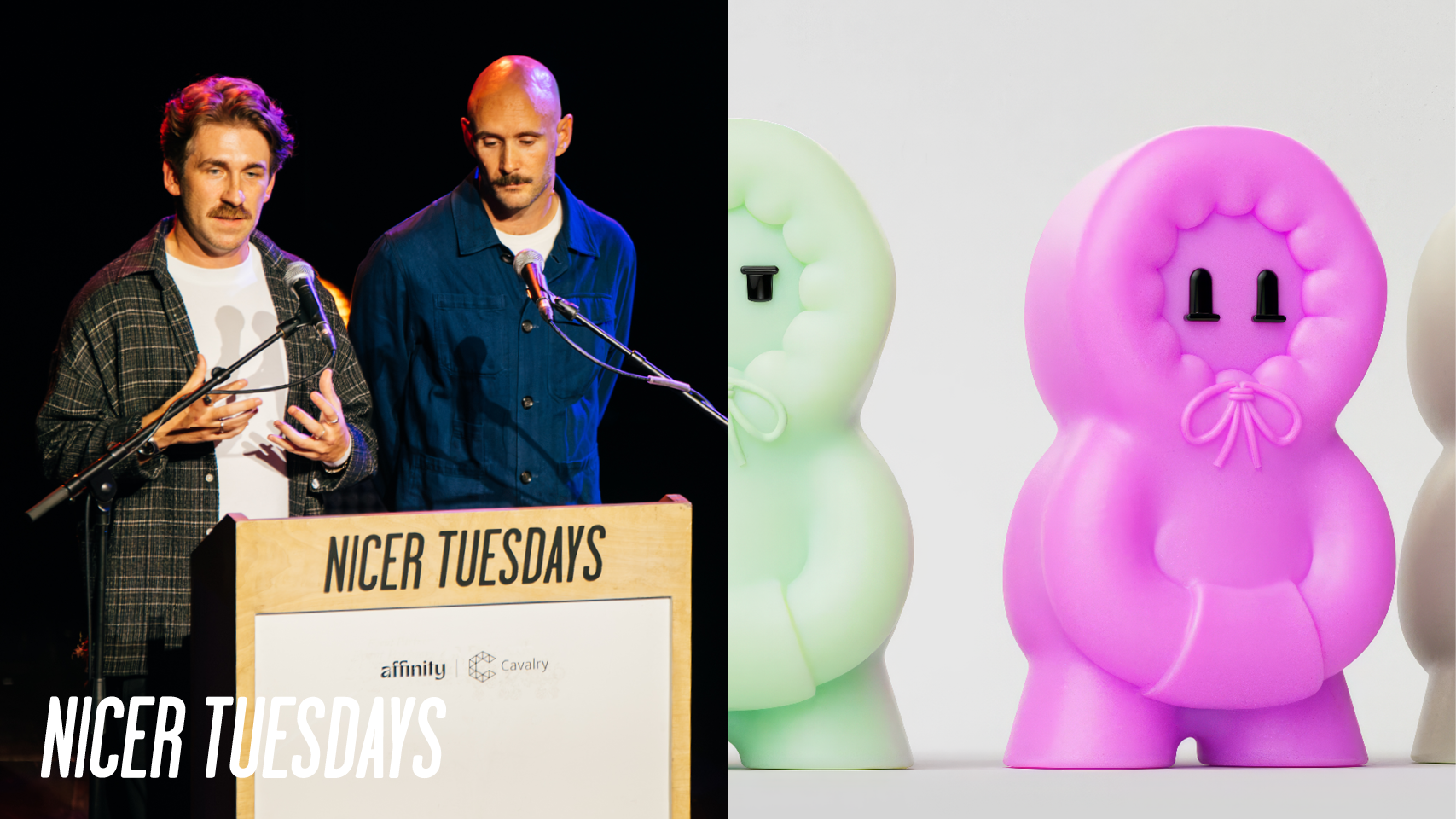
were based in Cornwall. So this is kind of an exciting new chapter in our sort of fairly young journey at the moment. We're really excited to kind of stand on the stage today and talk a little bit about some of our work, some of our process, hopefully kind of open the doors to sort of what we do at Studio Kilm.
We're a small little team. Here we are on stage. You can probably spot myself and Nate, but alongside us are some incredibly talented people that we're really, really pleased and privileged to work with every single day. Got Eduardo, Meg, Archie, Claudia, and Cass. a group of generalists that really have brand and design at the core of their practice. But now more and more are kind of asked uh probably pestered by us to kind of continue that practice into other realms. So we kind of happily walk into copy. We think very strategically.
We're really interested in digital and interaction design, but more and more what we're doing is bringing brands to life through motion design. There's only seven of us, which is uh kind of fun because we're a small little team that likes to kind of bolt on to other teams. We'll talk a little bit more about how we do that. Um, but to get us to this point, we've been working a little bit on our internal positioning and what our proposition, what on earth it is that we're doing in this big industry of design. And we've kind of got to this point, shaping brands from the inside.
And that idea of bolting on to teams is kind of instrumental in that style of thinking. So we tend to work with other creatives. We notice this actually that our work gets noticed and loved um and attention from other creatives as well. So those creatives also tend to work at quite interesting brands. Some of those brands are here. We seem to go on a bit of a streak of working with a lot of entertainment and broadcast brands, but we also enjoy working with tech brands, also a bunch of startups as well, but the common thread is that we're solving problems. We don't often come in and do a big rebrand. Sometimes we do,
sometimes we do a brand refresh. those projects are available to us. But actually where we find that we add the most value is when we work with internal teams that are experiencing a bit of a bottleneck, a bit of a problem. And we come in to look to solve that. [sighs] So we thought we'd open the talk with a Chapter 2: Project showreel short show reel that kind of summarizes a bunch of that work for you guys now.
[music] [music] [music] You just you just you just you just you just you just [music] you just you just you just you just you just you [music] [music] [music] [music] Get that for me. [music] [cheering] [applause] Chapter 3: Principles of brand design Thank you very much. Um, it's such an unusual moment to see that on such a big screen. It's really cool. Um, so as well as kind of explaining who we like who we like to work with, we want to kind of unpick a little bit of what was in there. We have kind of three principles that we like to build our work around.
The first is that the work needs to have soul. It needs an idea. We like to think that it needs a heartbeat. It needs something that people resonate with. They see something of themselves in the work and they want to interact with it and they want to find out more. The second is fairly straightforward. Make it real. We see a lot of fantastic work that exists on a case study. Maybe doesn't see it out into the real world or if it does, maybe it looks a little bit different. I think that we really love seeing the work that we create used for the purpose that it was created. Put it out in the real world and find people where they are.
Last but not least, and this is the one that we've started to gravitate around more and more, is it's about brand behavior. So, we hear a lot about kind of visual and verbal, and that's really important. We love those things, too. But actually, where we've really started to find a lot of excitement in our work is bringing brands to life through their behavior. So when we look at this our sort of tapestry of work, our kind of little patchwork of projects, we get more excited by the way things are moving and interacting and showing off.
So it could be a rebrand, it could be a refresh, it could be a brand system, a film, a website. You just want to explore them a little bit more. You want to dive into each of those squares and discover a little bit more about that brand because something in there is coming to life in a certain way that you didn't expect. And that's what we want to pose. as a question to you guys today. Can a brand have a body language? Chapter 4: ITV brand behavior project We all know what that means when it when it's kind of referred to as a a human being having body language, those subtle little cues that we interact with every
day. Well, we're kind of interested in this idea of a brand having body language. So, I'm going to hand over to Nate to explain a little bit more. So, yeah, as Charlie says, we we are sort of obsessed with brand behavior. And so we always use this as an open question to ourselves and we thought it could be a fun way to look back at some of our recent projects and see it through the lens of behavior and how each of those products and projects have unlocked from that point of view.
So the first project we started with this question can a brand behave like a lynch pin and for this this was for ITV. So a bit of context was that ITV had a really unique problem. They'd been on our screen for over 70 years. uh they had a whole host of sub channels, loads of different content for different people and it became quite a difficult brand to use. Also, ITV had sort of lost its master brand like the voice in the master brand. It it sort of lost its voice to all of the sub channels. So really, it was our job to put it back at the center of the brand and we had to figure out a way and how to do that. So we started by sketching. So I'll work from the bottom up. These are some of
our early sketches and we were just trying to figure out again we like to start with the way it behaves first rather than just the visual. So on the bottom row we were thinking well if ITV is so integral to their brand universe what if we think about it like DNA like sort of fibers maybe in the way that it could react with the second row up that second row we were thinking well if ITV is at the center of our homes maybe we treat ITV like this doorway and so as this doorway opens you get this sort of glow of light and that felt really nice and humble but there was actually something simpler with this which was the top row um where we started thinking about this idea that ITV could start to
have a gravity to it. And it was when we came to this sort of little diagram on the left there that we thought, well, there's something interesting about this ITV logo having a gravitational pull and literally holding all of this content together, taking it literally, literally putting it at the center of their brand universe. And so when you then zoomed in on that moment, as you can see on the right, you got this moment where the ITV logo locks in to the content and it starts scrolling through it. and it felt reminiscent of how we scroll through digital content, how we're used to moving through these panels now. So, it's a really simple idea, but it meant
that when it came into the team ITV um who work with us, it meant that it was really easy to use and that creative team could then build this out and evolve this in future. It was an idea that held together all of out of home, all across broadcast and it was still recognizable. it was always that the ITV logo was the catalyst at pulling people in to the content um for people to watch. So in this project, it was the behavior that clarified that relationship between that master brand and the universe of the content surrounding it in all of those sub channels. Chapter 5: RTS convention identity With the second project, it started with this question. Can a brand behave like it's overwhelmed?
So this really just a little bit of context again. This was for the RTS Cambridge convention. Um, and it's a chance for the broadcast industry to get together and all talk about the future of broadcast. And this year that we worked on it, they were talking about how the fact that this industry is really overwhelmed by so much content to watch and competing demand. So, we're all used to this feeling, right, of turning on our screens and just being completely overwhelmed. We don't know where to look. And so, they wanted to talk about that. So, when we came to do the brand identity for the event, we started quite literally. We thought,
well, okay, maybe we paint, we illustrate too much to watch. So, we like this idea that the identity generated too much and it started to get more and more and more. But as we were doing this and thinking about as people were sort of walking into the event, just felt very sort of neggy. It was very like a negative way of we couldn't we couldn't let that slide like it always felt negative regardless of how we sort of spun it. And it felt very literal. So then instead of thinking about it logically, we thought, well, what about basing it on the feeling of too much to watch? What if we made the identity behave like a overcrowded screen and all of these messages were sort of jostling for our attention as they were floating in and out? And so
when that then came across the whole brand identity, it started to feel a whole lot more joyful. And more than thinking it through and and understanding with in our mind what it was about, you could feel what it was about. You felt overwhelmed. And so when someone's up on the screen in front of this um talking through something really important, it provoked thought and conversation. We've talked about this project quite a lot. In fact, we probably are probably milking it by now really. But ultimately, this for us was the first time as a studio that we started to realize that this thing with branded behavior was something that we
really loved and we really enjoyed working in. So with this one, the thing that unlocked this was that we didn't illustrate too much to watch. We made the identity behave like too much to watch. Chapter 6: BAFTA creative journey So the third project we want to talk about is a new one. It's our work for BAFTA. And for that we wanted to kind of ask the question, can a brand behave like it's forming? By that we mean, can the brand kind of behave like it's unfinished or maybe taking the viewer or the the attendee on a journey along with the the other attendees at the event. So we started to explore this idea of creativity and that kind of like broad
idea of what an idea is at the beginning and how an idea ends up becoming something else at the end. For that we started to dive into Cavalry um and other motion softwares like Touch Designer to explore this idea of kind of using particles to create this idea of energy. And we like this because it sort of was ambiguous and that idea of coming up with a creative idea is kind of hard to put your finger on. So this chaos that begins at the start of an idea, there's something beautiful there, but you're not quite sure what it was and over time that finds its feet and it forms something. And in this instance, maybe it forms a piece of type, maybe it forms an an image, maybe it forms a
shape. That kind of central theme carried through the whole project. So there you can see on the left sort of this kind of chaotic but beautiful world. This idea that that at the beginning something is full of potential. But over time we can start to then bring in uh more direction to the particles.
They can form these shapes. BAFTA spoke to us about the idea of facets of a story. and they like this idea that these shapes could be these sort of gemstones, these kind of geometric forms that could kind of emerge out of nothing. So we used the particles as a way to do that. So having a starting point and having an ending point allowed us to kind of play with all the shades of gray in between. And that meant that we could take the viewer, we could take the attendee on a journey throughout all of the different awards that BAFTA does, linking them all together with this shared sense of creativity and an idea coming together. We also love the idea that sometimes it's possible to
overthink something and go, well, actually, is anyone going to really understand this when they're at the event? So, what is that kind of body language that you're actually picking up on? And this idea of magic started to come through a lot in this project. this idea that these particles were forming something beautiful, something sporadic, something that might then disappear again. But actually that's really when we think about going to a BAFTA event or associate something with BAFTA or just simply the idea of film, this idea of magic and craft and elegance was something that was really coming through
as well. So with this one, the behavior lets guests walk through that creative process. It lets them experience that creative idea that process that they too went on themselves and lets them immerse themselves in that entire journey. Chapter 7: Defining brand body language So when we come back to that question at the beginning of can a brand have a body language. I mean I think we would veer towards yes yes it can. But I think it's more nuanced and subjective than that. I think when we're talking about a person so much of how they communicate is beyond um the verbal and the visual of what they're saying or the way they
look. We pick up on these cues in terms of body language and how someone's saying something and the way they carry themselves all the time. We're constantly reading the room. I'm frantically reading the room now trying to figure out how we're doing in this for instance. And so we we naturally do that. And obviously when it comes to a brand, a brand isn't a person, but still so much of the way it behaves shows is how much of how we communicate. And for a brand that's so much of how we develop a personality around this. So when we look back at those projects when it came to ITV, it was the behavior of this that
created clarity. You understood what was at the center of the brand and what was periphery and you understood that relationship and intent every time it showed up. When it came to RTS, the behavior created a feeling and feelings hit so much quicker than a thought does. It was immediate. You could see it out of the corner of your eye and still understand what was being communicated to you. And I think also when we think more about how we react as people as well, if you're in a if you think back to a situation, you might not remember exactly what you did or someone else did, but you'll definitely remember how you felt in that scenario because
feelings stick for longer and resonate for longer. And in the case of BAFTA, it was the behavior of this that created a story. It created a narrative and a journey so that every time you saw this work and around the event, you could connect them to form a larger picture there. And so we realized when we look back at our work over the last four years or so, there was a a sort of trend really that in our case the the form often follows the behavior. Um I think when we did the RTS work, I think it was we got this comment in in press which said uh oh we don't know whether this started in motion or started in static and we thought oh that is a bit weird isn't it? that is quite novel maybe and but we didn't really realize how
integral that is to our process and and actually in all of our projects the way it looks seems to come second to the way it behaves and shows up and really to come back to what Charlie was saying at the beginning you know that's what gives this work soul it makes it feel a lot less lifeless when you can read deeper into the nuances of how this work reacts and lives and breathes in different moments and it also means it can work in the real world because it can show how it adapts and how it evolves to real world situations in future. So, it's been a lot of fun. Thanks so much.
Really appreciate it.
Latest Talks
-
Mother Design
Mother Design on why packaging is the only thing a designer can say to the customer
Watch -
Joanna Blémont
The importance of doing “bad drawings” to develop your style
Watch -
Lily Kong
How painting offers self-discovery and connection with memories
Watch -
Alfie Whiteman
From professional football to photographing toe wrestling
Watch -
Jazz Grant
Using mixed media as a narrative device for dual heritages
Watch -
Daisy Chain
Reimagining Crack Magazine with slime-inspired 3D motion design
Watch