
Mindy Seu
The art, aesthetics and history of sex on the internet
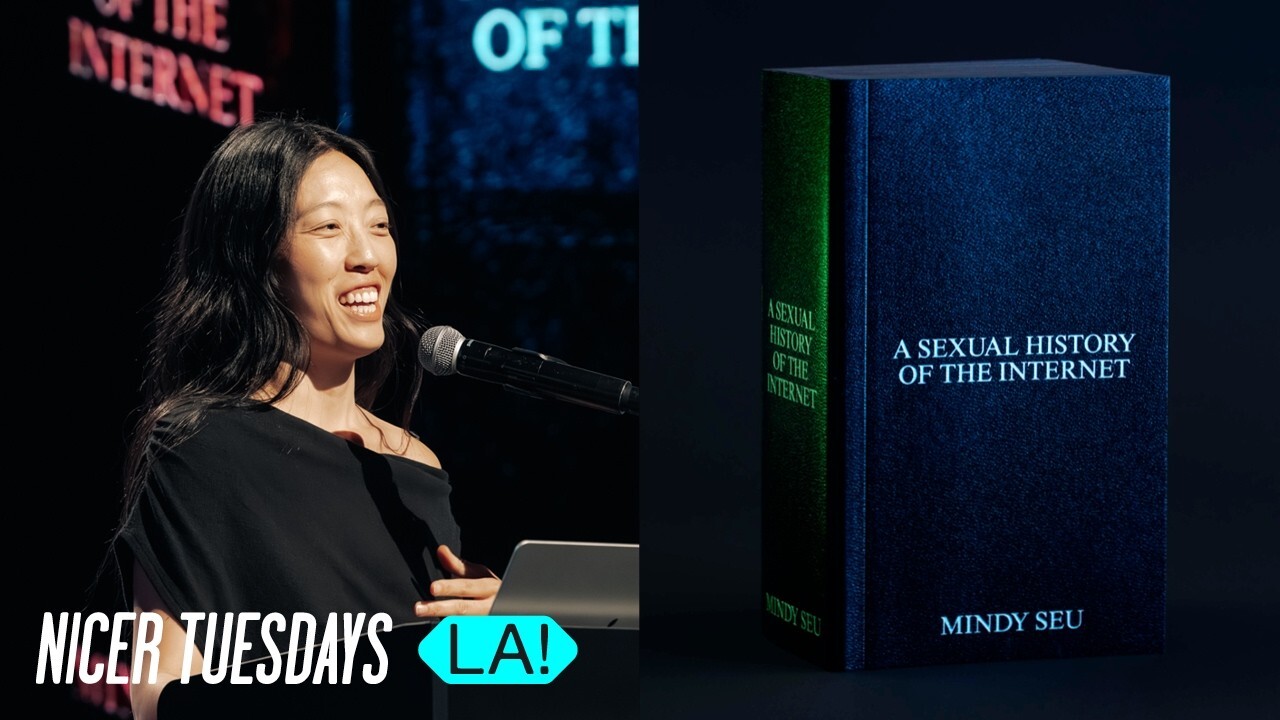
“It's interesting to see how broken our current systems of attribution, citation, and splits really are.”
[applause] Hello everyone. Bear with me for a second. I insisted that I do this with live links. So I have to switch over the screen, but it will make sense in a moment. So there's a reason why I like doing live links. Let me also set a timer. Um, my work is on and about the internet. Most of you will likely encounter my work online in some capacity and generally I like the internet because it's open access. So everything that you see here is a live link that you can view later on. This is actually using Arena. Does anyone use Arena?
Great. Arena heads everywhere. Um, but if you go to my channel, then you can find all of these slides and images here. So, today I'm going to be talking about a sexual history of the internet. It's kind of the baby of my first book that I published a few years ago called Cyber Feminism Index. Is anyone familiar with this big green encyclopedia?
Thank you. Um, in some ways they're very similar. They both have the same width spine of 2 something in. One is really a project of accumulation. It compiles hundreds of different excerpts of online activism, net art, and etc. from the past three decades. And a sexual history of the internet pulls one of those through lines about embodied technologies into a performance.
So the performance goes something like this. Imagine I asked you to pull out your phone and go to a Finina, a sexual history of the internet. Excuse me. This is also live. So if you want to look at these slides later, you can. I would coordinate all of you to pull out your phone. You go to the spinsta and even though we're taught to use these tools in a very conditioned way for Instagram, it's likely doom scrolling. If you actually let the interface do the work, it's actually very slow.
Chapter one, you're holding a tea dildonic. I was having drinks with Melody Hoff, an artist and sex cyberneticist, and they casually referred to the phone as a sex toy. A click or swipe on the screen accesses desire. On our phones, we sex, we send nudes. Apps scan our environments for erotic encounters.
Our phones responds to our touch. It's pressure sensitive. It vibrates. So, here you can see that we're all looking at it on the screen together. But imagine you were looking at this on your phone in a room full of a hundred others. It might look something like this. My friend joked that it looked like the dystopic version of a French impressionistic painting of people picnicking by a lake. Um, this was during our premiere of the performance at Pioneer Works in New York. You're in a room looking at your phone with hundreds of other people looking at theirs.
As Ben actively talked about, publishing is so important. One of my favorite quotes is by Andre Bratton and he says to publish is to find comrades. Books are also worldbuilding devices and to make these worlds you need huge teams. I'm so grateful to all of these people that I've worked with and many of them are friends and we're lucky to collaborate with them.
We are actively planning the uh summer tour of this performance. So if you're interested, go to a sexual historythe.com. [snorts] Okay. So the back of the book is uh covering these three sections. This book is a history. It gathers anecdotes, artworks, and historical artifacts that reveal the pervasive and perverted origins of our digital tools.
This book is a script. It's a faximile of the performance. And this book is an experiment. When you buy this book, profit is redistributed to the 45 people cited within. So chapter one, this book is a history. I'm going to run through this really fast because we only have 12 minutes. I'll just give some concrete examples.
There's a different channel on Arena that collects all of these different references. So, you're welcome to dig in, but let's just focus on a few. One that I love here is by Hannah Bear. Hannah Bear is a transwoman and an artist. She recently wrote this article for Art Forum in which she feeds her image into a deep fake revenge porn AI generator.
What she's met with is this cover, which is very small here, but you'll see that the she's unable to see the nude that it generates because it's behind a payw wall. If you look at this bottom corner, we see the sign tech, which was coined by Mistress Harley. Uh, she's a dominatrix, formerly an IT professional, but she's considered a sex worker, but doesn't actually have sex as we know it. There's no physical encounters, no nudity, no camming.
All she does is ask her submissives to give her remote access to their machines. She can then access their bank accounts, their social networks, all of their hidden files. And it really reminds me of this when I was teaching on Zoom and I had to get remote access to my students computers. And I'm sure you've experienced too if you ever had a problem with Adobe and I've asked for Adobe tech support. It just makes us question how power and visibility is built into these tools. And while you're seeing a lot of depictions of women and artists here, these are really questions about labor extraction, who has access
to what tools, and who actually made them. This book is a script. So imagine you're looking at your phone with a lot of other people. Instagram can actually be a publishing device and I really love working with artists because they tend to subvert the intended use of tools. Here we see LC on everyone's face because the performance was a participatory reading. Um the curator Paula Anteneelli described it as a Catholic mass because there was this constant recitation.
We also learned that site has the same root as recital. So to read someone's words aloud feels like an embodied way of giving a citation. This is the fina that we just looked at. So our challenge then when we were doing these beta tests was how can we translate this very ephemeral performance which keeps getting removed from its platform Instagram because of their very opaque content moderation tools and translate that into a book. I worked with Laura Combmes and gave her these slides.
So these are three of the chapters in the performance. We sped them up so you can see, but it's a mix of text slides, archival images, videos, etc. Our challenge then was in this very colorful environment with dynamic moving media, how do we translate that into a book? You'll also see that there's certain conventions here that we have to play with. If you leave a story on Instagram that's text, it's 5 seconds. A video is up to 1 minute. So, if you just let it autoplay, it's actually very, very slow.
So, our process of designing this book was really about trying to pull the primary elements, which was one, it has to be the size of a phone. And it is. It's the size of an iPhone. extruded to 700 pages. And it has to kind of act like as a flip book because we're changing the interface elements. We're making Instagram, a very fast device, very slow. And we're making a book, a very slow device, very very fast.
For the sake of time, I'm you can see all of these on Arena, but I'm just not going to talk about all of them. We also try to interpret what uh these colors might be. RGB is very hard to print as you all know for the designers in the room. So we instead try to instead make it a very mysterious object. We used black greeting card paper from Germany.
So not white paper printed black but actual black card stock. And we printed on it with very shiny metallic ink. So, the book is almost iniccernible unless you're moving it around to catch the light. I live in LA. Laura lives in New York. So, she would send me photos like this saying, "What kind of silver foil do you like?"
And when we printed it on the broad sheet, we were gagged about how beautiful this shiny silver ink really looked for all our different image types. Just for the sake of time, there's a bunch of production images and videos in here. If you're interested in printing, highly recommend you take a look. But I want to quickly talk about our third section.
Oh, and I had to throw in it's nice. Uh, thank you so much to Olivia Hingley. If you want to read more about the design element, she wrote this great article about the project. Okay, this book is a financial experiment. The first page of the book reads, "When you buy this book, profit will be redistributed to every person cited within a new model of attribution.
If you've published a book with the press, you might be familiar with this first diagram. This is the standard profit split for publishing. 90% goes to the publisher, 10% goes to the author or artist. That publisher 90% is actually doing a lot. They're figuring out production, figuring out warehousing, shipping, getting you a distributor, etc. But still, the split is pretty extreme. So, for a sexual history of the internet, we self-published and we are like, let's figure out a way to redistribute funds and perhaps find a more economical model of publishing.
For the 45 46 people in the performance, 45 in the book, we asked them, do you want to be part of this financial experiment and are you okay if we cite you? 27 opted in, four reallocated their share, six didn't reply, four are not living, five are not living, and four were unreachable. So, if the 27 people who opted in, if we sell out of the book, we printed 5,000 copies. We have about a,000 left. If we all sell out, then each person makes around 20 cents.
So, then collectively they would each earn around $800 to $900. So for a small artist project, I think it is an interesting way to see how this stuff can be redistributed and how broken our current systems of attribution, citation, and splits really are. These are all the people cited in the book. I did not mention who opted in or out.
And if you're actually interested in the numerical breakdown of how much everything costs, I highly recommend you look at this article on metal label. I'll let you know how much the book cost, how much it costs to ship, how much we're breaking down to each person, etc. Thank you so much. [applause]
Latest Talks
-
Mother Design
Mother Design on why packaging is the only thing a designer can say to the customer
Watch -
Lily Kong
How painting offers self-discovery and connection with memories
Watch -
Alfie Whiteman
From professional football to photographing toe wrestling
Watch -
Jazz Grant
Using mixed media as a narrative device for dual heritages
Watch -
Daisy Chain
Reimagining Crack Magazine with slime-inspired 3D motion design
Watch -
Kelli Anderson
Tactile typography and graphic design as fine art
Watch