Bill Rebholz
Taking ‘trash’ and turning it into beautiful vernacular signs
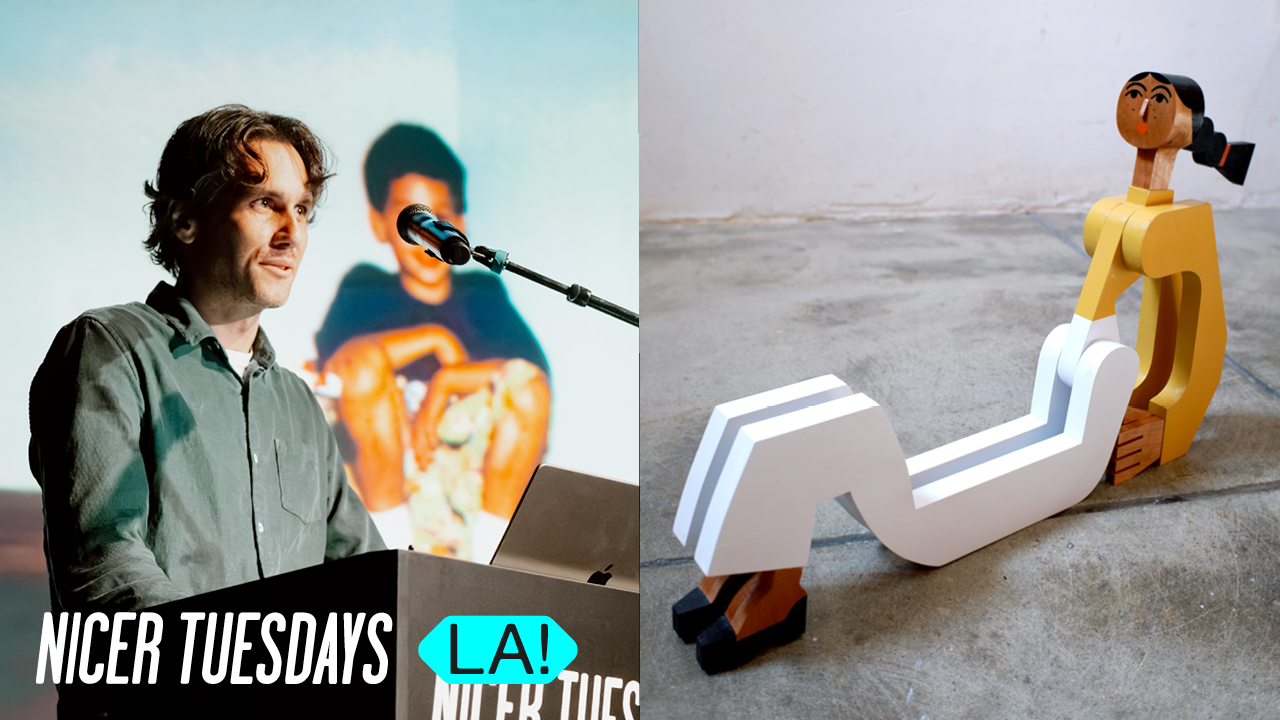
Hi everybody. Um, I'm Bill. I think it says that. Um, I'm an artist, a commercial artist. Oh, yeah. There we go. You hear better? Okay. So, yeah, I'm an artist, a commercial artist, and if you're remotely aware of who I am, it's probably from my illustration. Um, and I've done a lot of random stuff over the past 15ish years, like editorial art, package, surface design, whatever. Uh, whatever you call the Oh, sorry.
Whatever you call this. Um, this is an ongoing collaboration with um my friend Tom Lam Marsh who's a stellar bike frame designer and builder up in Portland. Had signs, murals and uh display as of more lately. Um, a little background. Uh, I grew up in Madison, Wisconsin. And in high school, I really had no academic ambitions or professional aspirations.
But I was a product of my environment. And being that my backyard was along a rail corridor, I found my way into painting graffiti. And um, I can attest that this was just wishful thinking. I carried on the tradition of outdoor drinking and graffiti art. Um but um outside outside of the painting part, I began to compulsively draw. And around the same time, I was um introduced to printmaking and attended a community center program where we drew and screen printed um posters for like the local emo show or like grind metal show um that were put on there. And through these newfound interests, I stumbled my way into enrolling at the area technical college for um to study design.
And in learning, I I just tried to like emulate the graphic world I grew up around. And for where I'm from, that meant remnants of things kind of like cemented in time. So like postindustrial city and and rural decrepitude like old facads, aged advertisements, billboards and the like. Um I wound up studying a lot of illustration and lettering and design ephemera of the same era. And uh through all of that I kind of stumbled into this notion of sign painting. Um, so which up until that point I was entirely unaware of as a concept but was kind of like steeped in subconsciously because of well a lifetime of examining
my surroundings and it became one of those things where you acknowledge something for the first time and all of a sudden you just see it everywhere you look and I just became obsessed with it as an idea. Um, so after two years of tech school, I transferred to the Minneapolis College of Art and Design to study illustration.
And um, the school part was undoubtedly good for me, but really what I did outside of it felt more important, which was painting as much graffiti as I could and um, also teaching myself how to letter with a brush uh, through lots of trial and error. These are like some um promotional flyers that I used to send to art directors as a way of practicing. Um a couple years out of school, I wound up meeting Phil Vandervart and Forest Wnjak, who are two staples of the Minneapolis sign painting. Um and I began to do some proper sign painting work with them.
Forest gave me a key to his shop and rented me some space to work in, which kind of became my de facto studio until I eventually moved out to New York. Uh, this was like a temporary little window display I made for his shop. We called it the information center. Um, primed in the stylings of the Midwest, moving out east provided me a whole new framework of reference to expand my own work against. And the thing I kind of picked up on the most or picked up the most on was like just the fear the sheer visual density of it. Um so yeah, for instance, like at first just collaging small gouache paintings um on paper
and then eventually kind of like moving into building my own panels and assembling them into patchworks. All of which kind of just like ultimately filters back into my own commercial work. Um I talk about this trajectory of sign painting because above all of the other many influences on my work. Um its applications and vernacular has for a long time informed the artwork that I make. Um and especially in technique and in construction.
Um so like ordinary things become more important by virtue of their presence and as a form format signage offers lots of shapes and scales and context to draw upon and it's like a world of floating information untethered from more traditional conventions of composition or even just like contextual elements.
So the grounding is found more through the like physical containers of the that the artwork occupies and um I just that kind of like becomes more composed through simple like graphic objects and motifs clustered together. So for me it's like uh the criteria for a sign becomes the criteria for a painting.
Um, I see the subject matter of my imagery kind of like words and the forms that define them like the individual glyphs making up the graphic language that I communicate through. Um, instead of kind of like a typical business then or a service-based sign, the messaging I depict becomes more about like symbol.
And symbols sort of the simplified form representing something abstract. The abstraction is about like gesture or feeling or moments or things I like or things I see or things I think about. Um like a shopping cart full of a bucket of flowers or a tow truck or a solen faces. Um sometimes it kind of verges into the more signike but um my objective is just more Um, another lane of work I explore is uh reinterpreting solicit solicitation ephemera, which I I kind of came up with that phrase because I don't really know what to call this, but like things like grocery mailers or like junk car cards and like by scaling them into giant objects. Um they and they're like things
that are typically discarded almost as immediately as they're doled out and they're a bit heavy-handed aesthetically as well, but I I find them interesting for those same reasons. And you know, it's again like more visual density, but by blowing them up in scale, it kind of allows them to be considered and seen um in a different way.
And it's kind of the same idea for some of these larger label paintings that I make as well. Um, so because I'm I make paintings in a a flatten kind of way, I introduce texture and depth through bolage. Um, so like a lot of found material. I'm always like hoarding garbage. Um, but like using a an amalgam of painting, paneling, framing, and sewing segmented imagery to build like physically build a composition. I think of the fragmentation kind of as an illusion to the facades and the signage that I use as reference and the individual panels become like the constructed substrates and the imagery inside of them being kind of like the pictorials or the lettering that you might find on a sign.
I'll wait for the last little guy in there. Okay, there we go. Um, this way of working keeps me engaged beyond just like image making by by learning like new technique and learning to use new machines or creating engineering problems for myself. And though my natural inclination is to make things as perfect as I can, I enjoy the results of coming up against the extent of my own abilities and technical knowhow and just kind of having to accept imperfection is the the sweet spot.
Oh yeah, this guy spins. Um it's also led me to other dimensions. For instance, the third dimension. um or or finding enjoyment making boxes. And it keeps me wondering, can a cabinet be a painting? Uh the cabinet is a placeholder for like a building feature. The the painting is the placeholder for a sign. Um so yeah, I I didn't get a driver's license until I was 25. So, I've always had a very pedestrian level or kind of passengers view of things. And uh at 15, my first job was a was at a grocery store, which taught me about taught me about and exposed me to the human condition like nothing else.
And so, my point of view and what I try to communicate in my artwork kind of comes from a similar perspective. Uh it's it's for anyone who's looking. Um, and to quote uh Phil Vandervart, my my one of my signed mentors, uh, I'm adding to the urban cacophony and I feel proud that I've affected the landscape. So, thanks for listening.
Latest Talks
-
ilovecreatives
“You’re not scattered, you’re multidimensional”: Own your slashiness
Watch -
The New Company
Why brand relevance is driven by novel ideas | The New Company
Watch -
No Ideas
Why self-publishing pays off
Watch -
Tala Schlossberg
What one year of committing to making more of what you love can do
Watch -
Arsh Raziuddin
How design can become a unifying language
Watch -

Mona Chalabi
Making sense of the unmeasurable
Watch